Wednesday, March 5, 2025

He Can't Sit Still (and that's ok)

If you ran a poll in my preschool classroom, asking the teacher, aids, and students who they thought was the troublemaker, all answers would float to one kid, Z. This classroom is a Special-Ed/IEP integrated classroom, contesting the old ways of complete separation of students, divided by differences. Z has a severe case of ADHD, where they cannot help but move around constantly, fidgeting with every little thing for some sort of sensory. When it's time to play, the students naturally float to one station, playing with a few toys at a time, considering their friends and what they're doing. 

But Z does the opposite; Almost ignoring everyone else's existence, he will bulldoze through a group of students, run to the full toy shelves, and swipe the entire row to the ground, making an absolute mess. His classmates start to cry as they are avalanched by wooden blocks and toy cars, and the teachers force Z to sit in the corner and isolate him in full. That's when he decides to stay alone in the corner, which he frequently doesn't, or not.

Z is a 4-year-old male black student from Providence. I know nothing of his home life or what kind of environment he lives in, but what I do know is that there is more to Z than the lash-outs that the teachers dread. 

He runs from corner to corner at all hours of the school day, but when it's rug time, I take a seat behind the rug on a miniature sofa. That is when Z comes over and sits right next to me, whether on my lap or leaning against me, he goes completely still. Fidgeting silently with one of the teacher's pop-it toys, Z and I quietly watch as the kids take part in the lesson. 

They think he doesn't understand, but that's not it. We don't understand, and once we open our minds, they will make us understand. It will just be in their own little way.

Sunday, March 2, 2025

"Troublemakers" by Carla Shalaby

In her book, "Troublemakers", Shalaby finds herself engrossed in the counterproductive ways that schools handle children who cause trouble. Whether that be physical outrage, talking back, or even slight disobedience of expectations, educators and administrators deal with this behavior negatively, confining the student into an academic life of limited options. During my time reading, I thoroughly enjoyed and appreciated Shalaby's vivid and impactful use of imagery, molding these societal issues many turn blind eyes to into crude metaphors. Spinning the rudimentary argument right around, she makes us think about what we might learn from those having conformity forced upon them. We tend to think we have to teach the person who does wrong a lesson, while helpful in many scenarios, children can teach us more of a lesson than we do them. Well, that's at least what I got from it, I don't know.


I pulled three quotes from the excerpts; One encapsulates her entire thesis into a statement and two are hard-hitting metaphors that paint a picture of what is being done to these "troublemakers":

~

"What is the role of education in the lives of children carrying the burden of this witness, breathing these poisons into their delicate lungs?" (xvii)

The innocence of a child is a gift frequently taken for granted. A life a person gets to live only once, their environment and the people occupying it being the driving factor for the duration in which a child may enjoy this blissful life. As educators we want our students to live in this innocence of imagination and curiosity as long as they can, protect them from what the outside world might be doing to knock them off this track. With this, however, comes the idea that we must not let our children remain naïve to the world; To find a balance of awareness and nurture is the ultimate goal of the picture-perfect teacher.


"We cage the birds singing most loudly" (xx)

External fits of rage tends to be a common form of expression for children who become frustrated, confused, and/or berated by superiors. All of which, frequent actions by teachers whom lack a sense of perspective for their “troubled students”. When a young student attempts to communicate their issues in a way that makes sense to their young mind, adults often interpret it as another day of acting out, sending them to the principal’s office soon after. The caged bird metaphor is directly parallel to how teachers treat the students who cry out for help. By caging up those who verbally attempt to open up their minds to us, we contradict our quintessential roles as an educator.


"This book is interested in Anthony...and in kids like him, but not what to do with him. I am concerned instead with what we might learn from him about what to do..." (xxxi)

With another use of figurative language, Shalaby displays the sole purpose of her book: Provide a voice of truth for those who failed to understand those that cry out for help, the “troublemakers”. Additionally, she adds the other main idea at the end of this quote by articulating her idea that these students shouldn’t be scolded or pummeled with reprimand, but rather a source for which we can better understand the mind of those we wish to enlighten. Students are just the ones who learn in the eyes of the naïve, but the important lessons lie within the words and actions of those we think need our help the most.

Friday, February 21, 2025

A Short History of Public Schooling

With public education, adopted originally in Massachusetts by the first State Director of a School Board, Horace Mann kickstarted a new trajectory that would be the standard of American Living for centuries to come. Nowadays, public school is obvious and set in stone, once in a blue moon we hear about homeschooling, as it has become a sort of oddity in our modern society. However, once upon a time some 150 years ago, people's homes were where they learned everything they ever needed to know. By learning at home, parents created the curriculum, which usually consisted of the essential chores to keep the family alive and well (cooking, cleaning, cloth making, etc.) and not a standardized method of doing long division.

The speakers of this short video essay argue that the public school system, set up originally by Mann but assimilated into every state's context accordingly, has killed creative pathways in our learning. They believe public schooling is a method of teaching by the book and to mold every child that passes through into an obedient subject of those who hold "power" over them.

This argument is not a foreign subject to me or really anyone who has ever discussed the role of education in our society. It is wildly evident through required standardized testing and recent evolutions of curriculum formats that the developments regarding school systems of our country, on both a federal and state level, have transformed into business and monetary-based mindsets. With schools that receive better accumulative scores on mandated standardized tests receiving more funding, it is no wonder teachers and administrators slowly teach more and more by the book each year. 

Creativity and imagination are being left in the dust in exchange for more money allocation, a benefit hardly finding its way to the students at all. That is not to say public education as a whole is a complete failure, and we were better off without it at all. Without the introduction of public education, access to numerous different skill sets and subjects would have never been made reachable for millions of students. Back before public education was established, we lived in a time of family-based sustainability, which requires children to be home to take care of livestock, the home, other children, etc. Who's to say we wouldn't be stuck in such a place now if it weren't for laws requiring some sort of education, whether public or private.

I would honestly go as far as to say life would be completely different in terms of development and entrepreneurship. Technology innovations we hold so dear like phones, computers, and tablets, are works at the hands of those who discovered an interest from watching people before them invent something. And those before them discovered their own interest from those before them as well. A pattern that I believe never would have started without getting children out of the house and away from a life of physical chores and into a place of thinking and self-discovery.

Friday, February 14, 2025

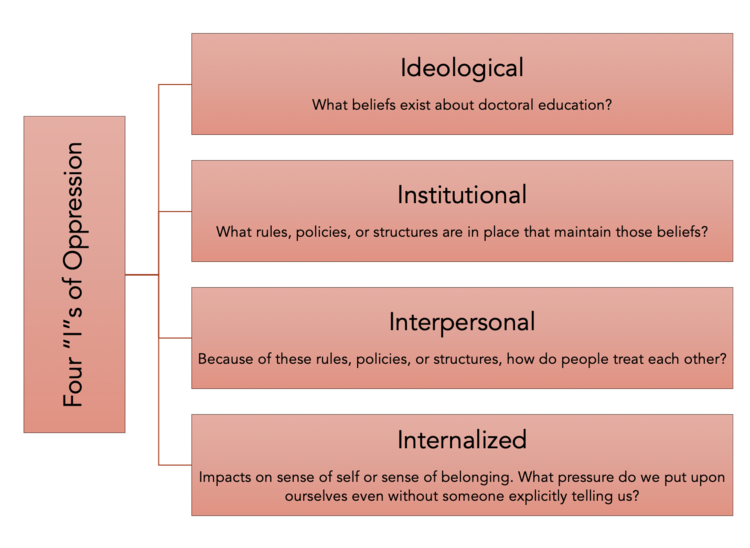
The Four I's of Oppression

After reading through this detailed and specific passage on an eye-opening way to view the world's systemic problems, I selected three quotes I feel cover the author's points in its fullest capacity...

                  The formation of scholars: Understanding graduate socialization through the  lens of oppression


"The antidote to internalized oppression is to participate in liberatory learning—education that accurately accounts for historical injustices and is rooted in anti-oppression values–and collective consciousness-raising with accountable self-reflection to identify what beliefs are harming oneself or others" (2)

Thoughts: In order to move past the faults of history, we must outline the issues that were caused by the behaviors of oppressors. By teaching the wrongs of those before us, those after us can have a much better grasp on how the world used to work, how it should work, and how to make it work in such a way.


"Interpersonal oppression has the most personal effects, but accountability and change require
identifying the root cause of the harm"  (4)

Thoughts: Although an extremely common idea brought up in texts such as these, it is, in my own opinion, probably the single most important introductory step into true permanent change in all our society's imbalances. To have those who do the wrong, whether intentional or not, live up to it and become educated on their own faults, we begin to strangle the issue as its roots and avoid the trickle-down effects like those we deal with today.


Oppressive ideological value systems do not remain dormant but express themselves at the individual, interpersonal, and social level through violence"  (2)

Thoughts: When a person whole-heartedly believes in something, whether that be political, religious, moral, etc, they tend to stop at nothing to live to their own truth. That does not change with those who continue to bear racist and homophobic pretenses. Active anti-inclusivity groups still hold meetings and exercise their beliefs on a normal basis, fortunately not nearly to the extreme as centuries past, but they are not to be dismissed.

Sunday, February 9, 2025

The Silenced Dialogue by Lisa Delpit

Jointing her own verbiage along with insightful personal experiences of various ethnic minorities, Lisa Delpit paints the picture of how prejudice and discrimination live in our everyday society. She describes what is currently in place "assisting" this issue and how much progress is truly being made today. Providing her personal opinion on the current status of teaching styles to close the ethnic gaps in our society, Delpit explains what the schools should, are, and aren't doing to solve the crisis millions of students face due to their background, whether ethnic or not. I pulled three quotes from this passage: one brings on a great point, one is a vulnerable experience, and the other I believe to be counter-intuitive and a hypocritically racist remark.


Understanding Anti-Discrimination Laws in Schools

"I try to give them my experiences, to explain they just look and nod...They really don't hear me...It becomes futile because they think they know everything about everyone" (Pg 22)

Thoughts: When something benefits us, why would we acknowledge an unfair access to such a thing? Regardless of how progressive you are, it is natural to protect your advantages. Still, when that advantage is unfair throughout society and based on a sensitive subject such as race or ethnicity, the conservation becomes messy. If solving this issue was as simple as all those who are privileged to admit to it, then this staggered societal structure would not exist. Nonetheless, to be ignorant enough to dismiss an underprivileged individual's issues (in the form of, for example, a mindless head nod), what progress can truly be made?


"Those with power are frequently least aware of - or least willing to acknowledge - its existence. Those with less power are often most aware of its existence" (Pg 26)

Thoughts: The major takeaway from this statement is the part of "least willing to". Those in majority power, demographically, socially, politically, etc, even when facing reality, work (either covertly or overtly) to deny their unfair upper hand. It's a piece of the impossible task of solving all socioeconomic issues in the world.


Delpit quotes Heath in Way With Words: "the verbal directives given by the middle-class...By contrast, many black teachers are more likely to say..." (Pg 34)

Thoughts: As I read this passage, I thought that Delpit brought numerous great points to the table, seemingly unbiased, with deep purpose, and backed by good insight. This extended spiel regarding speech on the basis of skin color seemed to undermine the whole message she acted to convey throughout the rest of the chapter. To assume the styles of parenting correlate with skin color is a counterintuitive point that works hypocritically against her other claims, which hold credibility in evidence and history.

Saturday, February 1, 2025

Privledge, Power, and Difference by Alan Johnson

From the eye-catching hook to his own insightful memories, Alan Johnson articulates the concepts of racial and ethnic discrimination in the form of easy consumption and genuine concern. As readers, we view the relevant issues through a lens that encapsulates the numerous consequences and imbalances in everyday life that we might naturally ignore. I selected three specific quotes that I felt encompass Johnson's message in its truest form:

-----------------------------------------------------------------------------------------------------

"The existence of privilege doesn't mean I didn't do a good job, of course, or that I don't deserve credit for it. What it does mean is that I'm also getting something that other people are denied" (Pg24)

Thoughts: When the idea of privilege is brought into discussion regarding an individual's success, it is natural for the person to defend their qualification for such success. It is disheartening for someone to have their accolades in life seen through a negative lens because they're white, straight, etc. In digression, the second sentence is the meat and potatoes of privilege as a societal issue; The thought that two people can produce identical work, of the same high quality, and receive skewed recognition is gross and unjust down to the roots of human nature. This simple but effective juxtaposition was a great way for Johnson to explain this problem to even the most uneducated.


"Racist isn't another word for 'bad white people,' just as patriarchy isn't a bit of nasty code for 'men.' Oppression and dominance name social realities that we can participate in without being oppressive or dominating people. And feminism isn't an ideology organized around being lesbian and hating men. But you'd never know by listening to how these words are used..." (Pg13)

Thoughts: Through the years and years of unrelenting efforts to lessen the effects of discrimination as a whole, the terms that find themselves caught up in the fight have seen slight deviations in their meanings. Although not maliciously and in most cases not purposely, certain meanings begin to warp, like a game of telephone. Unfortunately, media has its endless ways of changing things at their own will, and that goes for words that mean so much in a movement like those needed to reform the discrimination issues of the world. When the average person gets their news from the average station, people can be educated with uneducated information, which defeats the whole purpose.


"Ignoring privilege keeps us in a state of unreality, by promoting the illusion that difference itself is the problem...The real illusion connected to difference is the popular assumption that people are naturally afraid of what they don't know or understand." (Pg16)

Thoughts: Often by people with unrecognized privilege will believe that the problem is solidified and the fact that they're white, or straight, or male, or maybe all of them, that they just got lucky and that's just the way the world is. However, by doing this, they remain naive to the actual implications and causes of privilege which is seated in the unwillingness of change by many who reap the benefits of the systemical imbalances

A Final Reflection of Sorts

Throughout the semester, we did a large variety of assignments, ranging from large scale in dividual projects like the Key Assessment, or th...